COMMUNITY INTELLIGENCE 005
COMMUNITY INTELLIGENCE 005
The Tools Are Changing (And We’re Not Even in the Room)
There is a quiet revolution unfolding in the landscape of global technology, but you won't find it trending on Instagram or TikTok. While the mainstream news remains fixated on political theater and viral distractions, a fundamental shift is occurring within the world of Artificial Intelligence. Most Black households remain unaware that the ground beneath the digital economy is shifting. While we spend our collective energy debating culture and consuming trends, a new class of AI assistants is quietly redefining the very nature of productivity. If we are not intentional right now, we risk repeating a painful historical cycle: becoming the primary consumers of a technology we do not control.
What is OpenClaw?
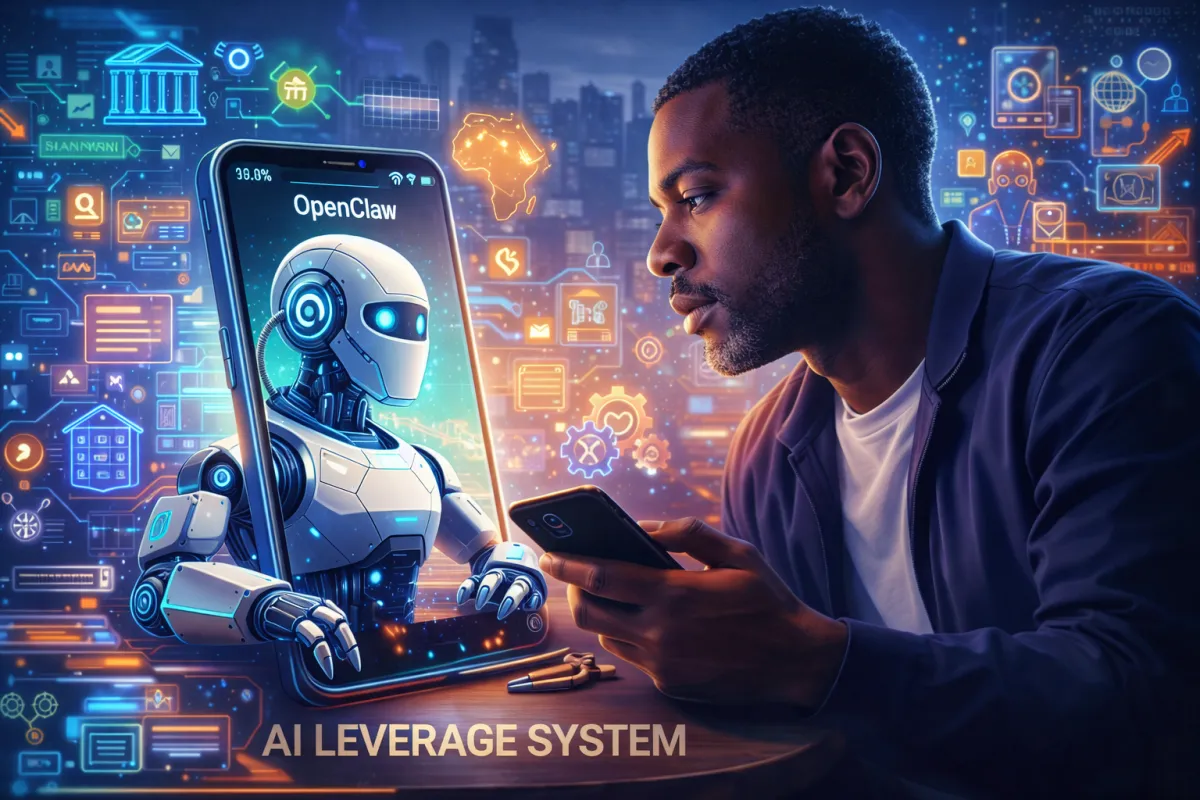
OpenClaw represents a departure from the AI tools the public has grown used to. It is not just another chatbot designed to summarize articles or write poems; it is an autonomous AI assistant. The distinction is critical. Traditional AI responds to prompts, but autonomous agents like OpenClaw execute objectives. They don’t just answer questions—they write code, automate complex workflows, manage digital systems, and make decisions within structured environments.
Operating like a high-level junior employee who never sleeps, requires no salary, and suffers no fatigue, these agents connect across various software tools to get work done. We are moving away from "Generative AI" that talks and toward "Agentic AI" that acts. This shift from conversation to execution changes everything about how a business operates.
Why This Matters More Than People Think
Every major technological leap in human history creates two distinct groups: those who master the tool and those who are replaced by it. The Industrial Revolution displaced manual labor; the internet eliminated the middleman; and basic automation phased out repetitive tasks. AI assistants are now coming for the "cognitive middle class."
Soon, entry-level analysts, administrative staff, customer support roles, and research assistants will find their job descriptions handled by autonomous agents. This isn’t a "someday" scenario—it is happening now. Those who understand how to deploy these tools will control output at 5x to 20x the efficiency of those who don’t. The uncomfortable truth we must face is that while other communities are building the infrastructure for this efficiency, the Black community is largely absent from the conversation.
The Information Gap is the Real Threat
The primary barrier to entry isn't a lack of intelligence; it is a lack of exposure. In elite professional and tech circles, AI agents like OpenClaw are already being integrated into business operations, investment research, and legal drafting. They are the "secret sauce" behind modern software development and automated marketing pipelines.
Meanwhile, in everyday Black environments, the conversation is still stuck on whether AI is "real" or "dangerous." By the time the mainstream conversation finally catches up, the infrastructure advantage will already be established by those who started today. This is how wealth gaps widen—not with a bang, but quietly, through the compounding advantage of superior tools.
What AI Agents Can Actually Do
To move past the hype, we have to look at the practical utility of these tools. For a business owner, an autonomous agent can manage CRM updates, analyze complex financial statements, and optimize marketing funnels without human intervention. It can write ad copy, run A/B testing logic, and generate operational documentation in seconds.
For the individual, these tools are equally transformative. They can automate the grueling process of job searching, manage calendar workflows, and even build the technical infrastructure for a side hustle. This isn’t futuristic science fiction; it is live technology available to anyone with the literacy to use it.
This is Bigger Than Productivity
At its core, this is a conversation about leverage. AI assistants are force multipliers that allow a single individual to operate with the output of a small team. This fundamentally changes hiring models, startup costs, and capital requirements. If a competitor is using AI to produce ten times your output at a fraction of the cost, you aren't just "behind"—you are being phased out of the market entirely. We cannot compete in a high-speed digital economy using low-leverage manual processes.
The Black Community and the Tool Gap
Historically, our relationship with technology has followed a predictable pattern: we adopt platforms late, use them primarily for entertainment, and monetize them as individuals rather than institutions. We mastered the algorithms of Instagram, YouTube, and TikTok, but we failed to build the underlying distribution networks or data ownership layers. We became the stars of the show, but we didn't own the theater. We cannot afford to make that mistake with AI. This time, we must move from asking "Can I profit from this?" to "How can this tool elevate the collective?"
Literacy as a Strategy
AI is not magic; it is software that processes language, executes tasks, and optimizes logic. The people who integrate it into their daily workflows will see reduced costs and accelerated production. The people who ignore it will work harder for less money until they become replaceable.
Imagine the power of AI-powered Black-owned firms operating with lean, scalable models, or AI-assisted educational hubs teaching our children to code and automate. This is the vision Keystone Black Capital is committed to. We understand that capital without technology is slow, and technology without ownership is just another form of dependency.
Final Thought
The world is not slowing down to wait for us to finish our cultural conversations. AI assistants like OpenClaw are not experiments; they are the new layer of operational power in the global economy. The question is no longer whether this technology is real. The only question that matters is whether we will choose to master these tools before we are forced to live in a world entirely defined by them.
The tools are here. The decision to lead or follow is ours.
Receive new research the day it publishes. Subscribe →
