
Capital Markets Memorandum 001
Capital Markets Memorandum 001
The $824 Billion Machine: The Securitization Market Black-Owned Banks Are Locked Out Of
Architectural Brief No. 008 proposed that Black-owned banks unite for scale. It named the problem — fragmentation — and described the mechanism — a shared securitization consortium — through which that fragmentation could be solved. What Brief No. 008 did not do, by design, was prove that the capital market those banks would be uniting to enter is real, liquid, and structurally accessible to a well-designed multi-originator platform. This Memorandum documents that market. The numbers are not aspirational. The legal structure is not theoretical. The market already exists, and it is running at scale — without Black-owned banks inside it.
The Number
In 2024, U.S. non-agency asset-backed securities issuance reached $946.8 billion— the second-largest annual volume on record, according to new SEC DERA datasets analyzed by FI-Desk. The figure nearly doubled the 2023 total.
Of that $946.8 billion,$824.5 billion was issued under Rule 144A— the SEC's private placement framework that permits securities sales to Qualified Institutional Buyers without full SEC registration. Rule 144A placements accounted for 87 percent of the year-on-year increase. The SEC's own data visualization platform confirms the breakdown by offering type.
Within that total:
$414 billionin Collateralized Loan Obligations (CLOs), all sold under Rule 144A, nearly quadrupling from the prior year
$145 billionin non-agency residential mortgage-backed securities (RMBS), almost entirely via private placement
$149 billionin auto ABS, setting a new record
A further $209 billion in "other" ABS — equipment leases, floor-plan receivables, and small-business loans — under Rule 144A
Freddie Mac alone issued $68 billion in multifamily securities in 2025, including $32.6 billion in K-Deals — structured instruments that have transferred interest rate, liquidity, and credit risk from taxpayers to private institutional investors at scale.
This is not a niche market.
This is the most liquid, most institutionally active fixed-income sector in the United States, running every quarter, pricing new deals every week, deploying hundreds of billions of dollars of pension fund, insurance company, and sovereign wealth fund capital into collateralized credit.
And it is running entirely without Black-owned banks.
Not because the assets are wrong. Minority Depository Institutions originate exactly the collateral this market is designed to absorb: commercial real estate loans, multifamily residential mortgages, and SBA-backed business credit. The FDIC's Q3 2024 MDI data shows MDI pretax return on assets at 1.59 percent — 38 basis points higher than the community bank peer ratio of 1.21 percent. Credit quality is not a barrier.
The barrier is structural. It is a minimum threshold problem — and it has a structural solution.
The Originate-to-Distribute Model: Step by Step
Before documenting why MDIs are excluded, this Memorandum must establish precisely what the machine is and how it operates. The originate-to-distribute model is not intuitive. It has to be walked through.
Step 1 — Originate. A bank underwrites and closes a loan. Commercial real estate, multifamily residential, SBA-backed. The loan goes on the bank's balance sheet. Required regulatory capital — typically 8 to 10 percent of risk-weighted assets — is set aside against it.
Step 2 — Aggregate. A sponsor or aggregator collects loans from one or more originating banks, standardizes the data, verifies collateral characteristics against stated eligibility criteria, and builds a pool of homogeneous assets large enough to structure.
Step 3 — Transfer to SPV. The aggregated loan pool is transferred, through a legally documented true sale, to a Special Purpose Vehicle — a Delaware Statutory Trust or Delaware LLC created for the sole purpose of holding this specific pool and issuing securities backed by it. Upon transfer, the loans leave the originating bank's balance sheet permanently. The bank receives cash. Its required regulatory capital is freed.
Step 4 — Issue Notes. The SPV issues structured securities — divided into tranches based on payment priority — to institutional investors. Senior notes are paid first and carry the lowest credit risk. Mezzanine notes absorb losses before the senior class. The equity tranche receives all remaining cash flow after senior and mezzanine obligations are met.
Step 5 — Investors Buy. Qualified Institutional Buyers — pension funds, insurance companies, asset managers — purchase the notes. They are not lending to the bank. They are buying a security backed by a specific pool of loans, isolated in a bankruptcy-remote vehicle. Their credit analysis focuses on pool statistics, structural protections, and credit enhancement — not on the originating bank's balance sheet.
Step 6 — Proceeds Flow Back. The cash raised from investors flows to the SPV, which uses it to pay the originating banks for the loans they sold. The banks receive their capital in weeks, not decades.
Step 7 — Originate Again. Freed capital flows back into the community as the next loan. The cycle repeats.
At a standard 10 percent risk-based capital requirement, every dollar of capital freed through a true sale into an SPV supports ten dollars of new lending capacity. That is the lending multiplier. It is not a theory. This is why JPMorgan Chase can originate hundreds of billions in mortgages annually without ever running out of room.
Portfolio lenders wait for loans to repay. Originate-to-distribute banks are never waiting.
Scale is not an advantage in banking. It is the minimum requirement for institutional power.
This is the mechanism that separates the two systems.
The Five-Entity Structure
A securitization transaction is not a bilateral deal between a bank and a buyer. It is a five-entity legal ecosystem, each participant with a defined contractual role, each isolation device serving a specific purpose in protecting investor capital from the credit risk of the originating institutions.
1. The Originator
The originator is the depository institution that underwrites and closes the underlying loans. In the context of a multi-originator MDI platform, the originator is the Black-owned bank itself — an institution like OneUnited Bank, Liberty Bank and Trust, Mechanics & Farmers Bank, Citizens Trust Bank, or Industrial Bank.
The originator brings three things to the transaction: regulatory charter, local credit knowledge, and loan origination capacity. It does not need to manage the downstream securitization process. It needs to originate loans that meet the agreed eligibility criteria, document them correctly, and transfer them cleanly.
The originator retains significant economic value even after the sale. As the servicer of the sold loans — collecting monthly payments, managing delinquencies, maintaining borrower relationships — the bank typically earns a servicing fee of 25 to 50 basis points on the unpaid principal balance of loans it has already sold. The community relationship remains intact. The balance-sheet risk does not.
2. The Sponsor / Aggregator
The sponsor is the transaction architect. It designs the deal structure, establishes eligibility criteria that all contributed loans must meet, coordinates with rating agencies, builds the investor presentation, manages warehouse line drawdowns, and maintains the ongoing investor relationship.
The aggregator is the entity that manufactures scale, transforming fragmented MDI origination into a single, institutionally coherent asset pool that the $824.5 billion Rule 144A market can price, rate, and absorb.
This is the role that does not currently exist for Black-owned banks. Large banks run this function internally, through their securitization desks. MDIs have no equivalent, because no single MDI generates sufficient deal flow to support one, and no neutral, mission-aligned third party has been built to serve the sector in aggregate.
Keystone Black Capital is building that entity.
3. The SPV: Delaware Statutory Trust
The Special Purpose Vehicle is the legal core of the transaction. It is a Delaware Statutory Trust (DST) — an entity created under the Delaware Statutory Trust Act with a single, explicitly limited purpose: hold the loan pool, issue the securities, and make the distributions.
The DST has no employees. No operations. No liabilities outside the transaction documents.
The critical legal attribute of the SPV is its bankruptcy remoteness— the rigorous legal isolation of the asset pool from the financial condition of any originating bank, the sponsor, or the servicer. If one MDI fails the week after selling loans into the SPV, the FDIC receivership cannot reach the sold loans. They belong to the SPV's noteholders. The originating bank's creditors have no claim against them.
This isolation is what makes institutional investors willing to buy securities backed by loans originated by small, locally focused banks they may never have analyzed directly. They are not taking credit risk on the institution. They are taking credit risk on the specific, legally isolated loan pool.
For structures involving real estate loans, the DST is also the vehicle of choice for Orphan SPV arrangements — in which the trust's beneficial ownership is held by a charitable trust, severing any corporate affiliation between the SPV and the originating institutions. This eliminates the risk that a bankruptcy court might apply the equitable doctrine of substantive consolidation to merge the SPV's assets with those of a failing bank.
4. The Servicer
After the true sale transfers legal title to the SPV, someone must collect monthly payments, monitor collateral values, manage borrower communications, and direct defaulted loans toward workout or liquidation. That entity is the servicer.
In most MDI securitization structures, the originating bank retains the servicing function under a Servicing Agreement. This is a deliberate structural feature for mission-aligned institutions: the bank surrenders balance-sheet risk while preserving its community-facing role. Borrowers never experience a disruption. The bank continues to hold the economic and relational value of its local presence while its capital is freed to deploy again.
5. The Investors: QIBs
The investors are the Qualified Institutional Buyers (QIBs) who purchase the securities that the SPV issues. Under Rule 144A, a QIB is an entity — pension fund, insurance company, registered investment company, bank acting for its own account — that owns and invests on a discretionary basis at least $100 million in securities. That threshold is not arbitrary: it ensures the buyer has the institutional infrastructure to conduct independent due diligence on a complex structured product without the protection of SEC registration-level disclosure.
These investors are not passive capital pools indifferent to what they buy. They are actively seeking high-quality, performing, collateralized fixed-income yield. Pension fund CIOs managing liability-matching portfolios are specifically seeking structured credit assets with predictable amortization schedules, real collateral, and institutional-grade legal structures.
MDI loan books contain exactly this collateral. The match exists.
The infrastructure to make the match has not yet been made.
The Legal Engineering: Bankruptcy Remoteness in Detail
The price of admission to the Rule 144A market is legal certainty. Rating agencies will not assign investment-grade ratings — and institutional investors will not commit capital — unless the bankruptcy remoteness of the SPV's assets is enforceable, documented, and independently verified. Getting there requires four specific legal mechanisms.
True Sale (FASB ASC 860)
The transfer of loans from the MDI to the SPV must constitute a true sale— a legal and accounting determination that the originating bank has permanently and unconditionally relinquished control over the transferred assets.
Under FASB ASC 860 (the successor to SFAS 166), a transfer qualifies as a sale when: (1) the transferred assets have been isolated from the transferor — placed beyond the reach of the transferor's creditors even in bankruptcy; (2) the transferee has the right to pledge or exchange the assets; and (3) the transferor does not maintain effective control through repurchase agreements or other mechanisms that would allow it to reclaim the specific assets.
The legal vehicle is a Master Loan Sale Agreement (MLSA)— a detailed contract containing the originating bank's representations and warranties about each transferred loan: origination date, outstanding principal, current debt service coverage ratio, current LTV, absence of material defaults, and absence of undisclosed liens. If a loan is later found to have breached these representations — a fraudulent appraisal slipped through, a lien was undisclosed — the originating bank may be required to repurchase that specific loan. But the pool has been sold. The capital has been freed. The breach is a bilateral remediation event, not a structural collapse.
The distinction between a true sale and a participation agreement is critical and often misunderstood. A participation transfers a beneficial interest in cash flows but leaves legal title with the originating bank. In a participation, the participating investor may have claims against a failed bank's estate that compete with other creditors. For a Rule 144A transaction targeting institutional investors and rating agency certification, a true sale via MLSA is not optional.
Bankruptcy Remoteness Devices
The Limited Purpose Clause restricts the SPV's organizational documents to prohibit any business activity other than holding the specific loan pool and issuing the specific securities. The SPV cannot accept deposits, make new loans, hire employees, or enter into contracts unrelated to the transaction. This prevents any unexpected liabilities from accumulating inside the vehicle.
The Independent Manager is a director or trustee who is legally and financially independent of every transaction party — the originators, sponsor, servicer, and investors. The Independent Manager's affirmative consent is required before the SPV can file for voluntary bankruptcy. This provision makes voluntary bankruptcy of the SPV extremely difficult to execute, protecting noteholders against the originating banks or sponsor using the SPV's insolvency as a strategic instrument.
The Non-Petition Covenant requires every transaction party — originators, servicers, investors, the sponsor — to agree contractually that they will not initiate involuntary insolvency proceedings against the SPV until at least one year and one day after all outstanding notes are fully retired. This waiting period exceeds the 90-day preference period under the U.S. Bankruptcy Code, ensuring that even in a worst-case scenario, the transaction fully unwinds before any insolvency proceeding could interfere.
Separateness Covenants require the SPV to maintain its operational independence: separate books and records, separate bank accounts, no commingling of funds with the originators or sponsor, no assumption of the liabilities of any other entity. These covenants are the documentary evidence that supports the legal conclusion of separateness — and they are what rating agency legal counsel reviews before assigning a bankruptcy-remoteness opinion.
The Regulatory Framework
Rule 144A and QIB Qualification
A public securities offering requires compliance with SEC Regulation AB — a disclosure and registration regime that, for the pool sizes a MDI aggregation platform would initially produce, carries fixed costs that are simply not economically feasible. The alternative is Rule 144A: the SEC's private placement safe harbor, which permits securities sales to QIBs without registration.
The Rule 144A ABS market is the operative market for this discussion. The SEC's datashows $824.5 billion in 144A ABS issuance in 2024 alone. The investors in this market are exactly the institutions that are actively seeking high-quality, CRA-eligible, real estate-backed yield and that have formalized impact-investment mandates requiring them to identify qualifying deployments at scale.
The practice note: Rule 144A requires that the issuer provide QIBs with access to sufficient information to conduct independent due diligence. In practice, this means a comprehensive investor presentation — pool-level statistics, loan-level data tapes, originator profiles, legal opinions, cash flow modeling under stress scenarios, and rating agency preliminary assessments. Keystone's aggregator function is specifically designed to manufacture this documentation.
Investment Company Act: Section 3(c)(5)(C)
The SPV must avoid classification as an "investment company" under the Investment Company Act of 1940, which would impose mutual fund restrictions entirely incompatible with a securitization vehicle. For MDI pools concentrated in whole mortgage loans and commercial real estate, the preferred exemption is Section 3(c)(5)(C)— the real estate exemption.
To qualify: at least 55 percent of the SPV's total assets must be "qualifying" real estate interests (whole mortgage loans, mortgage liens), and at least 25 percent must be "real estate-related" assets. Given that MDI loan books run approximately 70 percent concentrated in residential and commercial real estate, the 3(c)(5)(C) exemption is structurally aligned with standard MDI asset composition — not a stretch to reach, but a natural fit.
For pools with broader asset diversity, Section 3(c)(7)— the "Qualified Purchaser" exemption — permits an unlimited number of investors provided each meets the $25 million investable-assets threshold.
The Volcker Rule: Loan Securitization Exclusion
The Volcker Rule prohibits banking entities — and any MDI is a banking entity — from owning an "ownership interest" in a "covered fund." This creates an apparent problem: if participating MDIs want to hold the equity tranche or mezzanine notes of the SPV, they may be characterized as owning a covered fund interest.
The resolution is the Loan Securitization Exclusion: an SPV that holds only loans and related servicing assets, and does not hold a significant amount of securities, is excluded from the definition of a "covered fund" under the Volcker Rule's implementing regulations. A multi-originator MDI pool composed entirely of whole CRE, multifamily, and SBA loans — no derivative positions, no bonds, no structured securities held as assets — qualifies for this exclusion. Participating MDIs can hold residual interests in the SPV without Volcker Rule exposure.
The precedent for CRA-eligible securitized MBS structures involving mission-aligned originators is already established: the CDFI Fund's portfolio optimization training materials document that CDFI MDIs already sell residential CRA loans into CRA-eligible MBS pools, with bank buyers purchasing those securities for CRA Investment Test credit. The institutional infrastructure for mission-aligned ABS already exists. What has not been built is the non-agency, multi-originator CRE and multifamily platform specifically for Black-owned banks.
Credit Enhancement: Engineering Institutional-Grade Securities
Institutional investors do not buy unrated loan pools from community banks. To access QIB capital, the SPV must engineer credit enhancement— structural features that make the issued securities materially safer than the underlying loan pool.
Tranching and Subordination
The SPV issues multiple classes of securities with different payment priorities in the cash flow waterfall:
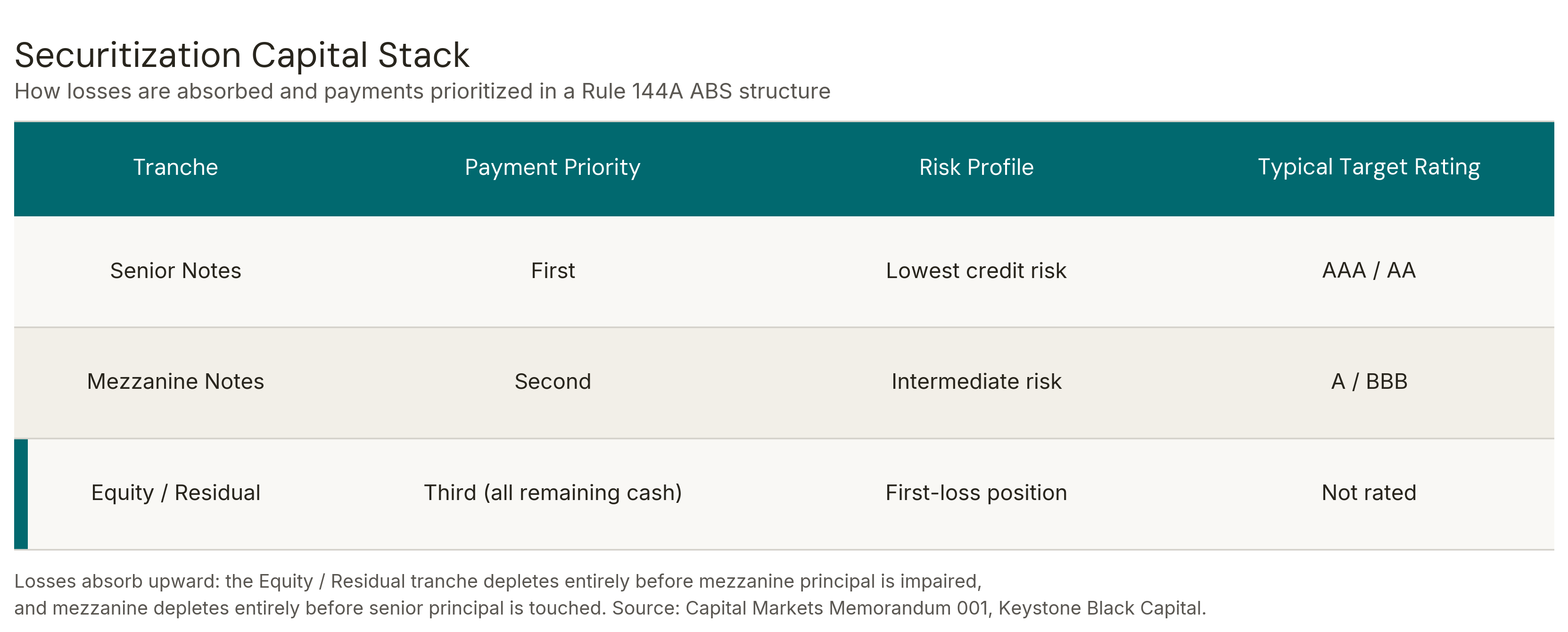
Losses in the underlying loan pool are absorbed first by the equity tranche — entirely depleting it before the first dollar of mezzanine principal is impaired, and entirely depleting the mezzanine before the first dollar of senior principal is impaired. This structural subordination is why a well-constructed ABS pool backed by community-bank CRE loans can achieve AAA ratings on its senior class while the underlying assets carry meaningful individual credit risk. The senior notes are not backed by the weakest loan in the pool. They are backed by every other tranche first.
Over-Collateralization
The SPV holds more assets than the face value of the notes it issues. A pool of $115 million in loans supporting $100 million in issued notes provides $15 million in over-collateralization — an additional loss buffer that must be exhausted before noteholder principal is at risk.
Excess Spread
The weighted average interest rate on the loan pool will exceed the weighted average coupon paid to noteholders. That difference — the excess spread— is the deal's built-in ongoing loss absorber. If the pool earns 7.5 percent and investors are paid 5.0 percent, the 2.5 percent excess spread on a $100 million pool generates $2.5 million annually in available credit protection, directed monthly into a reserve account or to the equity holder.
The equity tranche receives all residual cash flow after senior and mezzanine obligations are paid — principal, interest, fees, and reserve account requirements. In a well-structured deal, the structural spread between pool yield and note coupons concentrates meaningful economic return in the equity position. At a 2 percent structural spread on a $100 million pool, that is $2 million per year in residual cash flow. At $500 million under management, it is $10 million annually. This is what structured-finance professionals call structural wealth— income generated not from originating individual loans, but from architecting the system through which loan origination becomes institutional capital.
The Threshold Problem: Why MDIs Are Locked Out
The threshold for economic viability in the Rule 144A ABS market is a pool size of approximately $100 million in homogeneous, standardized loans — the minimum at which fixed legal, structuring, rating agency, and investor relations costs can be amortized into a spread that clears the market.
The median MDI has approximately $475 million in total assets. Its loan book is a fraction of that — and its eligible homogeneous loans in any one asset class are a fraction of the loan book.
No single Black-owned bank can build a $100 million pool from its own origination alone in any timeframe that is commercially viable.
This is the exclusion mechanism. It is not a credit quality barrier. It is not a regulatory prohibition. It is a minimum-scale threshold that was set by the economics of the institutional market — and that no individual MDI, operating in isolation, can reach.
Ten MDIs can reach it. A multi-originator platform can reach it — and then scale beyond it.
The CDFI Fund's own documentation already establishes the regulatory precedent that CRA-eligible securitized structures can be built around MDI loan origination.Freddie Mac's $68 billion in multifamily securities in 2025— including $32.6 billion in K-Deals that transfer credit risk to private institutional investors — demonstrates that the multifamily loan asset class MDIs originate most heavily is precisely the collateral type the institutional securitization market has demonstrated it will absorb at scale.
The math has always worked. Ten $10-to-15 million loan books, pooled through a shared SPV with standardized eligibility criteria, standardized data tapes, and a neutral aggregator managing the investor interface, reach the threshold. The coordination infrastructure — not the credit quality, not the regulatory framework, not the investor appetite — is the missing piece.
What Comes Next
This Memorandum proves the market exists.
It documents the exact five-entity structure through which that market is accessed. It describes the legal mechanisms — true sale, bankruptcy remoteness, Limited Purpose Clause, Independent Manager, Non-Petition Covenant — that make institutional capital willing to buy securities backed by loans from small, community-based originators. It identifies the regulatory exemptions — 3(c)(5)(C), Rule 144A, the Loan Securitization Exclusion — that make the platform operable under existing law.
The $824.5 billion Rule 144A ABS market is not waiting for Black banks to show up. It is pricing new deals every week, deploying institutional capital into structures built by institutions that had the infrastructure to access it.
The market will not come to MDIs. MDIs — coordinated through a shared, institutional-grade platform — must come to the market.
Memorandum 002 will document why accessing this market is not optional for Black-owned banks. It will prove numerically — through a direct cost simulation — why the structural constraint analyzed in this Memorandum compounds into an existential cost disadvantage for every MDI operating today, and why securitization is the only structural path out of that trap.
What's next at Keystone
Memorandum 002, published May 12, presents the mathematical proof of the Small-Bank Tax — a direct simulation comparing what a $500 million MDI and a $30 billion regional bank each pay for the same compliance, technology, and audit infrastructure, and what the numbers mean for the survivability of the MDI sector. To engage with this work — bank operators seeking dialogue, capital stewards seeking proximity, researchers seeking critique — contact [email protected].
