ARCHITECTURAL BRIEFING 005
Why HBCUs Struggle to Compete And Why That Matters Beyond Culture
Growing up, HBCUs were special to me. They were community, culture, brotherhood, and belonging, a place where Black excellence felt visible. I went from a PWI (Predominantly White Institution) environment into the world of HBCUs, and the contrast was undeniable. Not in the warmth or pride of the community but in operations, infrastructure, and execution.
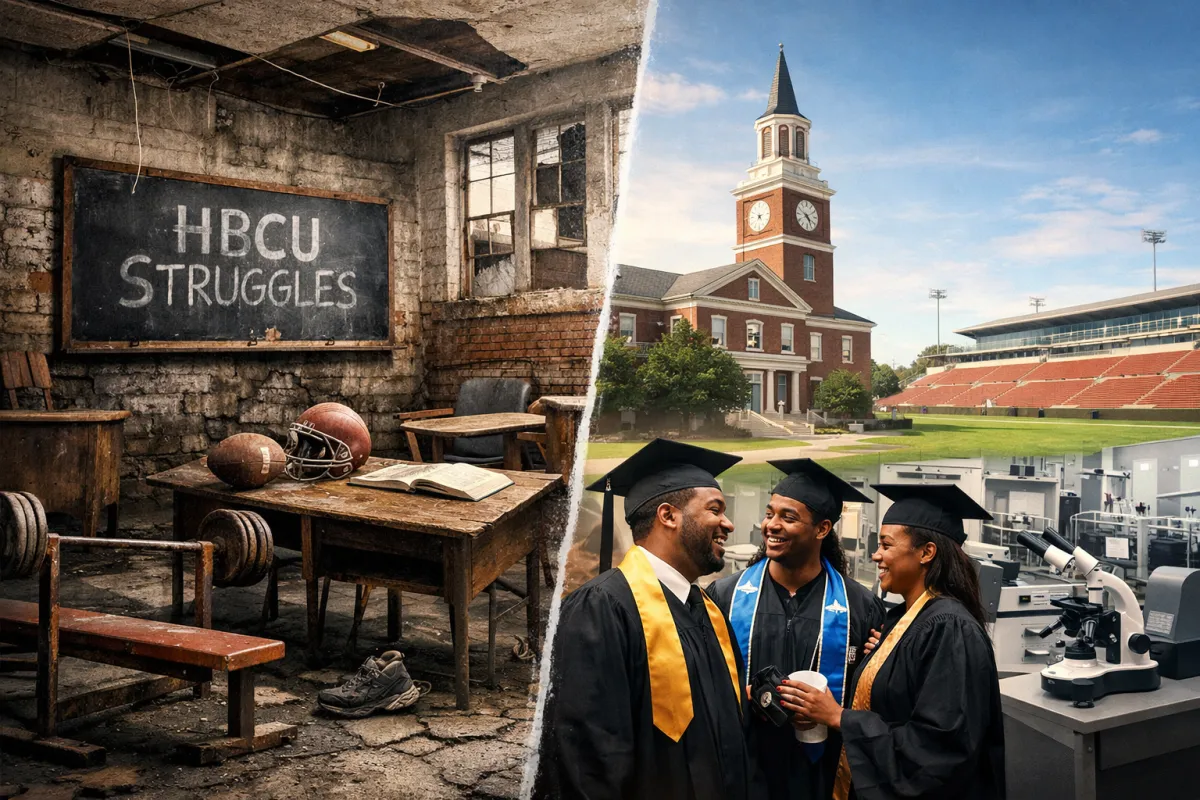
Schedules weren’t always posted on time. Financial aid processing lagged. Administrative systems creaked. Locker rooms and weight rooms looked like they were frozen in time. It wasn’t just my campus; it’s a pattern reported across HBCUs.
And when you step back and look beyond the cultural affection we all have for these institutions and at the data, a deeper structural issue reveals itself: HBCUs are not resourced or structured to compete at the level their peers do.
The Funding Gap Isn’t A Theory; It’s Data
One of the most consistent findings across research is that HBCUs operate with far fewer financial resources than predominantly white colleges with similar enrollment and mission.
Public HBCUs often receive more than half their revenue from federal, state, and local funding, a heavier reliance than other universities, but the amounts just aren’t proportional.
A report highlighted that HBCUs missed $12.8 billion in potential funding due to decades of unequal distribution, affecting everything from instruction to student services.
Endowment disparities are stark: some studies show public HBCUs averaging less than $7,300 per student, while comparable public non-HBCUs approach $25,000 per student.
That gap directly affects all operational facets, from building renovation to technology upgrades to staffing levels and research capacity.
Deferred Maintenance and Dilapidated Infrastructure
A survey of HBCU campuses found that many have staggering deferred maintenance backlogs of tens of millions of dollars simply because routine upkeep has been postponed due to a lack of funds.
This is the same issue I saw firsthand: decades-old facilities that haven’t kept pace with modern needs. You can talk about pride and tradition, but when the buildings don’t function efficiently, the student experience suffers, and that impacts retention, recruitment, and academic competitiveness.
Disproportionate Distribution of Federal Research Dollars
HBCUs are engines of Black intellectual growth and produce a disproportionate share of Black graduates in STEM and other fields.
Yet, when it comes to federal research funding, a critical source of income and prestige in higher education, HBCUs receive a fraction of their fair share. Recent data shows HBCUs received under 1% of federal R&D expenditures in 2023, despite representing over 3% of degree-granting institutions.
Less research funding means fewer labs, fewer grants, fewer hiring opportunities for faculty, and fewer pathways for students to participate in cutting-edge innovation.
Historical and Systemic Underinvestment
Part of the problem goes back centuries. Federal and state funding models have historically disadvantaged HBCUs, both explicitly and through neglect.
For example, a federal analysis revealed that 16 states underfunded their historically Black land-grant institutions by about $12.6 billion over three decades, even though the law requires equitable treatment.
While these disparities are slowly getting attention, even prompting letters from the U.S. Secretary of Education urging states to fund equitably, decades of underinvestment cannot be fixed overnight.
The Culture of “Enough” Over Excellence
This brings me back to your lived experience.
I believe the same dysfunction we critique in Black-owned banking institutions, being comfortable with existence instead of demanding competitiveness, appears in how many of us talk about HBCUs.
We celebrate being an HBCU. That pride is real and rooted in history and identity. But celebration shouldn’t excuse underperformance or structural neglect.
For HBCUs to truly thrive in the 21st century:
Funding must be equitable and predictable.
Endowments must grow to competitive levels.
Infrastructure must support modern academic and research needs.
Administrative systems should function efficiently, not as a source of frustration.
We should expect more, because these institutions are not just cultural treasures; they’re critical drivers of Black social mobility and national innovation.
The Potential Beyond the Gaps
This isn’t a critique without hope.
HBCUs already outperform expectations in many areas. They enroll a disproportionate number of Black students and consistently produce high percentages of Black graduates—especially in STEM and fields critical to economic mobility.
When philanthropists and policymakers invest intelligently, such as recent multi-million-dollar commitments for endowment strengthening and infrastructure support, the narrative can change.
But we have to be honest about the problem first.
Conclusion
I love HBCUs. I also challenge us to hold them, and ourselves, to real standards of excellence. We can honor culture without excusing structural deficiencies.
The problems HBCUs face, chronic underfunding, outdated infrastructure, and research funding gaps, are not personal failings. They are system failures.
If we want institutions that not only exist but also compete, then we have to start talking about scale, capital, performance, and readiness not just history and pride.
That’s the conversation I want to push.
And it starts with data.
Receive new research the day it publishes. Subscribe →
