ARCHITECTURAL BRIEFING 012
ARCHITECTURAL BRIEFING 012
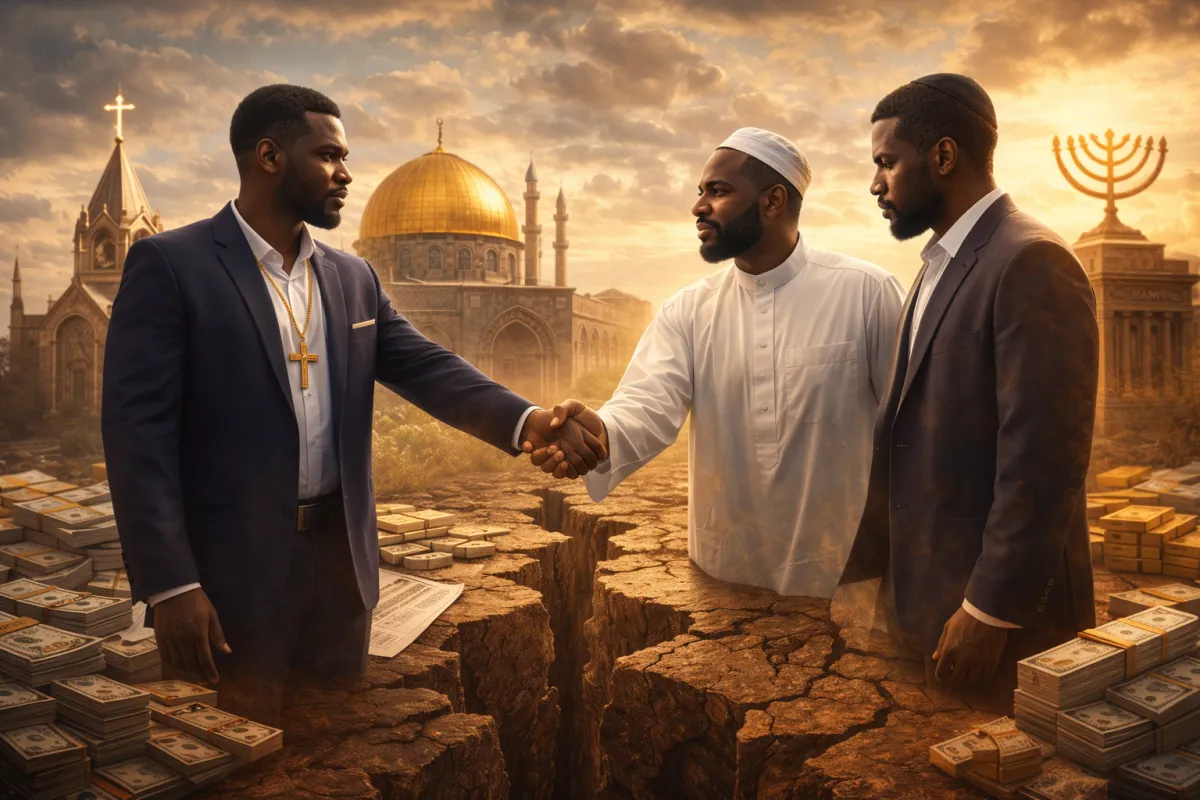
The Cost of Division: How Religious Barriers Are Blocking Black Economic Power
One of the most uncomfortable conversations in the Black community isn’t about money, politics, or even race.
It’s about religion.
Across the Black diaspora, religion has become one of the most powerful dividing lines preventing economic cooperation. Christians hesitate to partner with Muslims. Muslims distrust partnerships with Christians or Jews. Spiritual beliefs, denominations, and doctrines quietly determine who we believe we can and cannot build with.
The result?
We remain divided while others consolidate power.
Religion Was Never Meant to Replace Strategy
Faith has always played a central role in Black survival. Churches, mosques, and spiritual communities provided refuge, identity, and resilience when institutions excluded us.
But somewhere along the way, belief systems began to replace economic strategy.
Today, religion is often used, consciously or unconsciously, as a gatekeeping mechanism:
“I can’t do business with them, they believe differently.”
“Our values don’t align.”
“I don’t trust their intentions.”
Meanwhile, capital does not care about belief. Money flows where cooperation exists.
Other Communities Don’t Build This Way
Look closely at communities that have successfully built multi-generational economic ecosystems.
Jewish communities partner across levels of observance, from secular to orthodox, because the institution matters more than the ideology.
In parts of the Middle East and Asia, Muslims partner with Christians, Hindus, and Jews regularly through joint ventures, banks, and trade alliances.
Their rule is simple:
Belief governs personal life
Strategy governs economic life
The Black community often reverses this.
Division Is a Luxury We Can’t Afford
When Black people refuse to work together across religious lines, several things happen:
Capital stays fragmented
Businesses stay small
Institutions never scale
Wealth never compounds
We end up with passionate individuals, but weak systems. And systems, not beliefs, are what last generations.
Faith Should Guide Ethics, Not Limit Infrastructure
This is not an argument against faith. It’s an argument against allowing faith to block cooperation.
You don’t need to pray the same way to co-own a bank, build housing, fund businesses, create credit systems, or establish institutions.
What you need is shared economic goals, clear governance, aligned incentives, long-term vision.
The Truth No One Wants to Say
The Black community doesn’t lack belief. It lacks institutional alignment.
We are divided by:
religion
denomination
ideology
identity
ego
While others are unified by:
economics
ownership
systems
scale
You cannot build a Black Wall Street if every brick requires agreement on theology.
Economics Is the Neutral Ground
Economic systems are one of the few spaces where Christians, Muslims, Jews, spiritualists, and secular thinkers can all participate without compromising belief.
Money is not a god.
It is a tool. And tools require coordination, not conversion.
What Keystone Black Capital Represents
Keystone Black Capital is not a religious project.
It is an institutional one.
Its foundation is simple:
Build systems that outlive individuals
Create structures that scale beyond identity
Unite capital around shared economic destiny
Faith belongs in your heart. Institutions belong in the world.
The Real Question
If we can march together.
If we can protest together.
If we can suffer together.
Why can’t we build together?
Until the Black community learns to separate belief from infrastructure, we will continue to inherit passion but leave no institutions behind.
And belief without institutions does not create legacy.
Receive new research the day it publishes. Subscribe →
