ARCHITECTURAL BRIEFING 013
ARCHITECTURAL BRIEFING 013
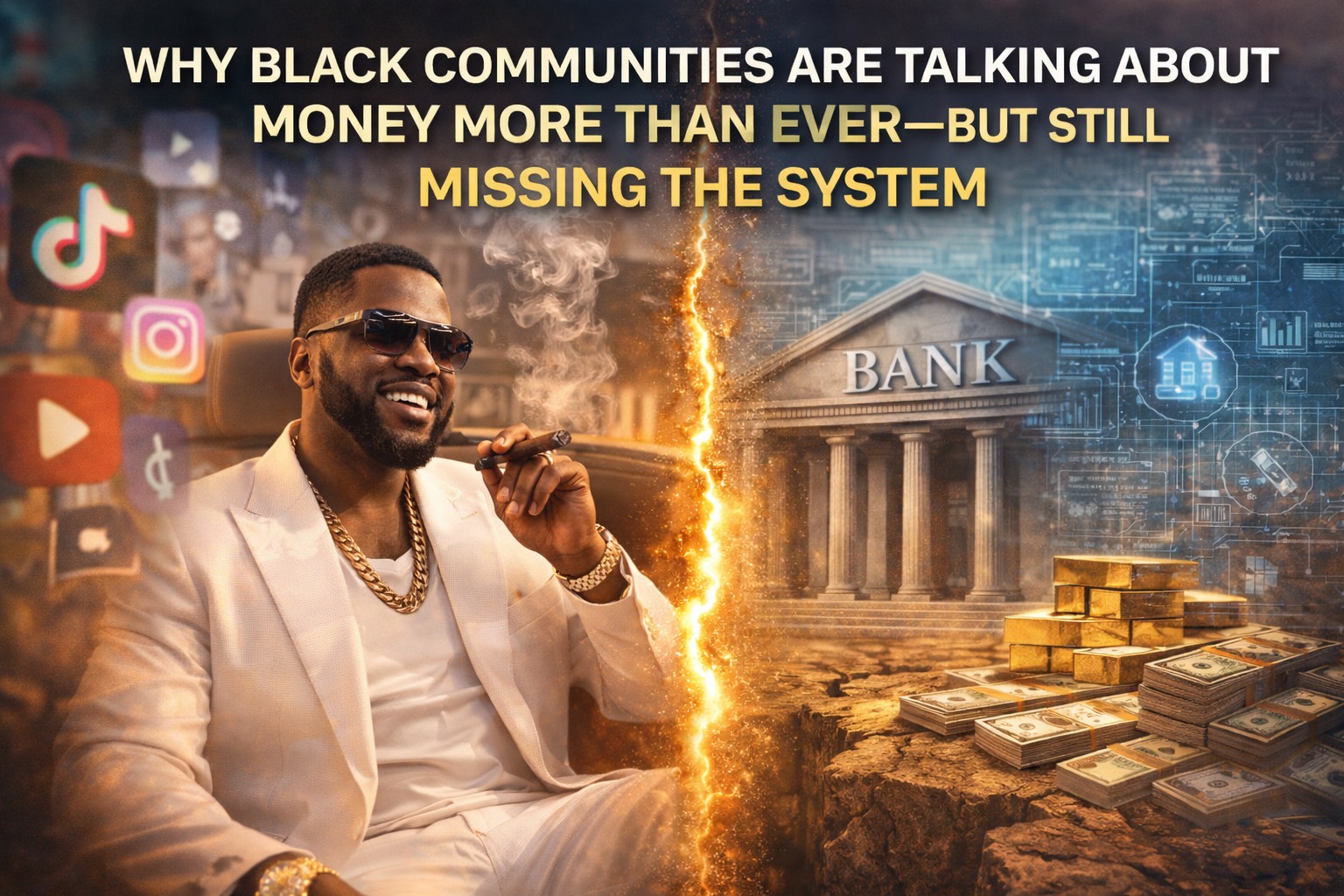
Why Black Communities Are Talking About Money More Than Ever But Still Missing the System
The Black community has never talked about money this much. Credit. Investing. Hustle. Entrepreneurship. Ownership. Wealth. The conversation is loud. It’s everywhere. And on the surface, it looks like progress.
But here’s the uncomfortable truth: We’re having more financial conversations than ever while owning less of the system than we should.
That contradiction is the moment we’re living in. And if we don’t understand it, this wave of awareness will fade without producing lasting power.
Awareness Has Exploded. Infrastructure Has Not.
Since 2020, something shifted.
Inflation hit households hard. Layoffs made “job security” feel fictional. Social media flooded timelines with financial advice. AI and automation forced people to rethink income entirely.
As a result, Black communities started talking about money openly and urgently. But awareness alone does not change outcomes. Every financial system on Earth rewards infrastructure, not conversation.
Banks don’t scale because people talk about money. Markets don’t move because people hustle harder. Wealth compounds because systems are built to hold it, recycle it, and protect it.
And that’s the layer we’re still missing.
The Financial Literacy Trap
For years, the solution offered to Black economic inequality was “financial literacy.” Learn to budget. Learn to save. Learn to invest.
Those things matter, but they are incomplete.
Financial literacy teaches individuals how to behave inside a system they do not control. It does not teach how capital is pooled; how institutions are designed; how leverage is created; how risk is distributed;or how power compounds over generations
That’s why we see a pattern repeat. Individuals improve. Communities do not.
Social Media Made Wealth Look Personal
Social media accelerated the problem. It rewards individual success stories, personal brands, viral financial hacks, and fast wins and visible lifestyles.
What it does not reward is slow institution-building, shared balance sheets, coordination, or boring but durable systems.
So, we celebrate the person who made six figures, the person who bought property, or the person who “figured it out.”
Meanwhile, the underlying structure remains unchanged. Visibility replaced durability. And visibility does not survive economic cycles.
Hustle Is Up. Leverage Is Still Missing.
Black ambition has never been the problem. Work ethic isn’t the issue. Creativity isn’t the issue. Drive isn’t the issue.
The missing ingredient is leverage.
Leverage is what allows:
one dollar to do the work of ten
one institution to outlive its founders
one generation to carry the next
Without leverage, hustle becomes exhaustion. And without institutions, leverage remains individual fragile, temporary, and easy to extract from the community.
Why This Moment Is Actually Dangerous
This is the part few people want to say out loud.
High awareness without infrastructure is unstable.
It creates frustration when outcomes don’t match effort. It creates competition instead of coordination. It creates suspicion instead of trust, and it allows individuals to escape instead of collective progress.
We start fighting each other for proximity to money instead of building systems that hold it.
That’s how movements stall. They don’t stall from lack of passion but from lack of structure.
The Real Divide Isn’t Wealth. It’s Systems.
Other communities don’t win because they’re more disciplined.
They win because capital is pooled, institutions are shared, mistakes are absorbed collectively, knowledge is normalized early, and systems outlast individuals.
They convert awareness into architecture.
That is the step Black communities have been systematically denied and internally discouraged from building.
What Keystone Black Capital Is Actually About
Keystone Black Capital is not about motivation. It’s not about hustle culture.
It’s not about selling financial products.
It exists to address the missing layer:
Institutional literacy.
How systems work.
How capital moves.
How leverage is designed.
How coordination changes outcomes.
The goal is not more conversations about money.
The goal is ownership of the machinery that money runs through.
Awareness Is the Beginning. Systems Are the Destination.
This moment matters.
If we stop at conversation, this wave will pass.
If we stop at individual wins, the gap will persist.
If we stop at visibility, power will remain external.
But if awareness becomes coordination…
If education becomes infrastructure…
If ambition becomes institutions…
Then this moment becomes a turning point.
Not just for income.
Not just for wealth.
But for control, durability, and legacy.
And that’s the work ahead.
Receive new research the day it publishes. Subscribe →
