ARCHITECTURAL BRIEFING 002
ARCHITECTURAL BRIEFING 002
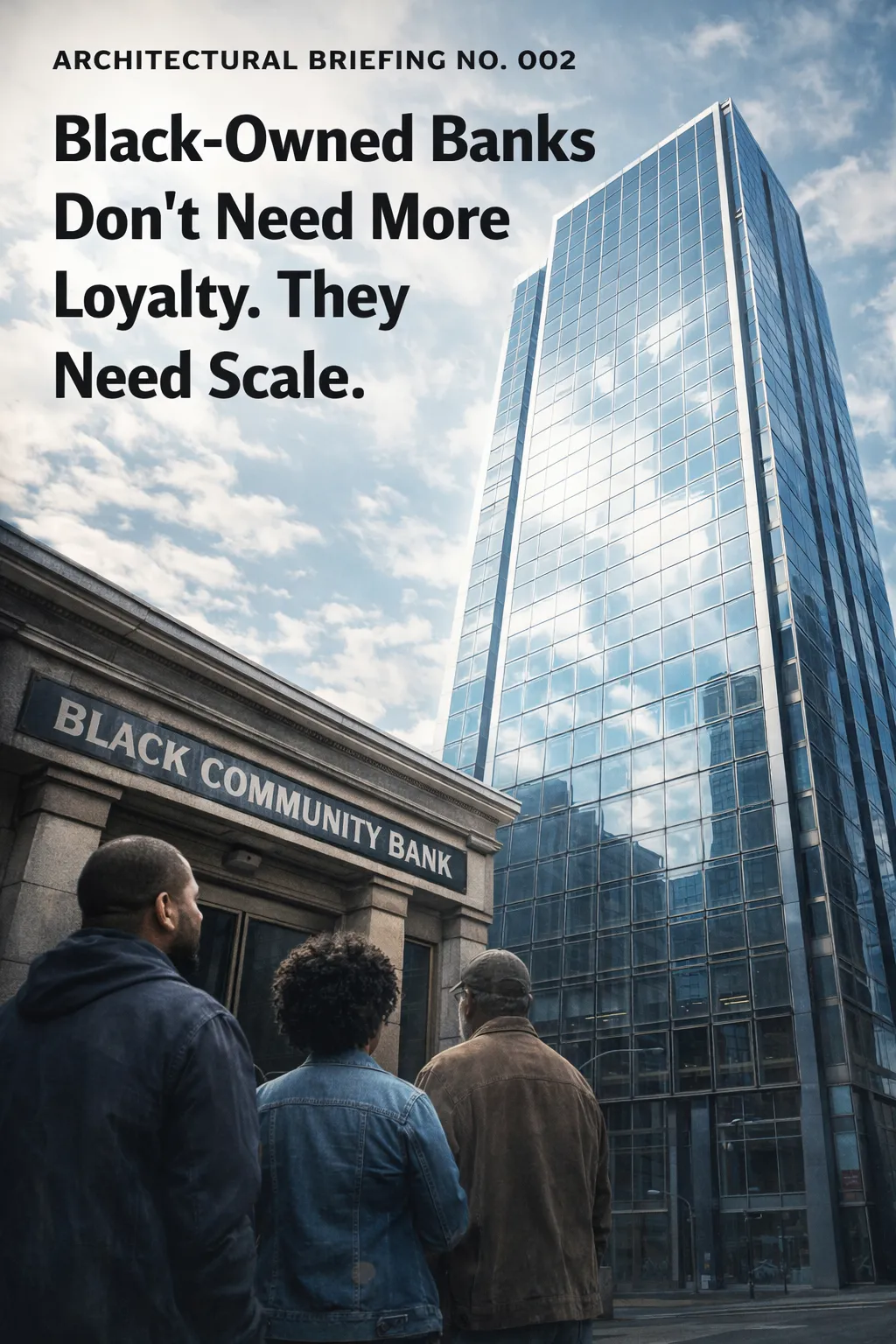
Black-Owned Banks Don’t Need More Loyalty. They Need Scale.
Black-owned banks are routinely discussed as cultural symbols rather than financial institutions.
They are praised for existing. They are encouraged to be supported. They are framed as causes rather than competitors.
This framing is well-intentioned and structurally damaging.
Because banks do not grow on loyalty. They grow on scale.
The Misdiagnosis
The dominant narrative surrounding Black-owned banks assumes the primary problem is insufficient community support.
The solution, therefore, is framed as:
● move deposits,
● open accounts,
● encourage loyalty,
● “bank Black.”
While deposits matter, this diagnosis confuses participation with capacity.
A bank can be supported and still remain structurally constrained.
Loyalty does not:
● absorb compliance costs,
● finance technology modernization,
● build underwriting teams,
● or expand balance sheets meaningfully.
Scale does.
The Scale Reality
Modern banking is not a relationship business alone. It is an infrastructure business.
As of mid-2024, Minority Depository Institutions (MDIs) collectively held over $360 billion in assets, with the average MDI holding roughly $475 million. Within that ecosystem, Black-owned banks represent a small fraction—often operating well below the asset thresholds required for diversification and resilience.
To put this in perspective:
Banks operating below $1 billion in assets face:
disproportionate regulatory and cybersecurity costs,
limited ability to diversify revenue streams,
constrained risk tolerance,
and minimal room for strategic error.
This is not a judgment.
It is a balance-sheet reality.
Scale is not about prestige.
It is about operational freedom.
Why Survival Becomes Stagnation
When institutions are structurally small, they are forced into narrow business models. Most Black-owned banks, like many small community banks, are concentrated in:
basic consumer deposits,
mortgages,
auto loans,
credit cards,
and limited small-business lending.
These products are necessary, but they are not sufficient.
The profit pools that create institutional power reside elsewhere:
middle-market cash-flow lending,
Treasury management and payments,
fee-based services,
and balance-sheet sophistication.
Without scale, entry into these areas is restricted not by vision but by capacity. The result is a cycle where:
survival is prioritized over expansion,
caution replaces innovation,
and institutions remain perpetually defensive.
This is how stagnation masquerades as stability.
Loyalty Is Not a Strategy
Telling communities to “support Black banks” without a corresponding scale strategy creates a false sense of progress.
It places responsibility on individuals while ignoring institutional constraints. No major bank achieved dominance through loyalty alone.
They achieved it through:
capitalization,
consolidation,
governance discipline,
product diversification,
and long-horizon patience.
Black-owned banks deserve the same conditions not symbolic applause.
What Scale Actually Enables
Scale is not an abstract goal.
It enables specific institutional capabilities:
Commercial & Middle-Market Lending--Lending to operating businesses with cash flow, not just startups or micro-enterprises.
Treasury Management & Payments--ACH, wires, payroll, merchant services, and cash management platforms that anchor business relationships.
Technology & Risk Infrastructure--Modern cores, cybersecurity, fraud controls, and data analytics that regulators expect and customers demand.
4.Talent Depth
Underwriters, risk managers, and operators capable of executing complex strategies.
5. Strategic Flexibility The ability to weather rate cycles, regulatory shifts, and economic volatility without retrenchment.
Without these, institutions remain constrained regardless of intent.
The Uncomfortable Question
The real question is not whether Black-owned banks should be supported.
The question is:
Why are we comfortable with Black financial institutions being permanently small?
Until scale becomes the explicit objective—discussed openly and pursued deliberately—the ecosystem will remain trapped in a cycle of symbolic survival rather than institutional growth.
Reframing the Conversation
A serious conversation about Black-owned banks must move beyond sentiment.
It must focus on:
● capitalization strategies,
● consolidation pathways,
● shared services models,
● governance modernization,
● and long-term institutional design.
This does not diminish the importance of community support. It contextualizes it.
Support without scale is sentiment. Scale with discipline is power.
Closing
Black-owned banks do not need to be protected from scrutiny. They need to be positioned for competition.
The future of Black banking will not be determined by loyalty campaigns. It will be determined by whether institutions are designed to grow.
Scale is not optional. It is the requirement.
Keystone Black Capital
Capital Intelligence for Ownership & Institutional Design Architectural Briefing No. 002
Receive new research the day it publishes. Subscribe →
