COMMUNITY INTELLIGENCE 007
COMMUNITY INTELLIGENCE 007
Why Are We Afraid of Credit?
There is a hard truth about money in America that most people are never taught:
People who build wealth do not do it by avoiding credit. They do it by understanding how to use it.
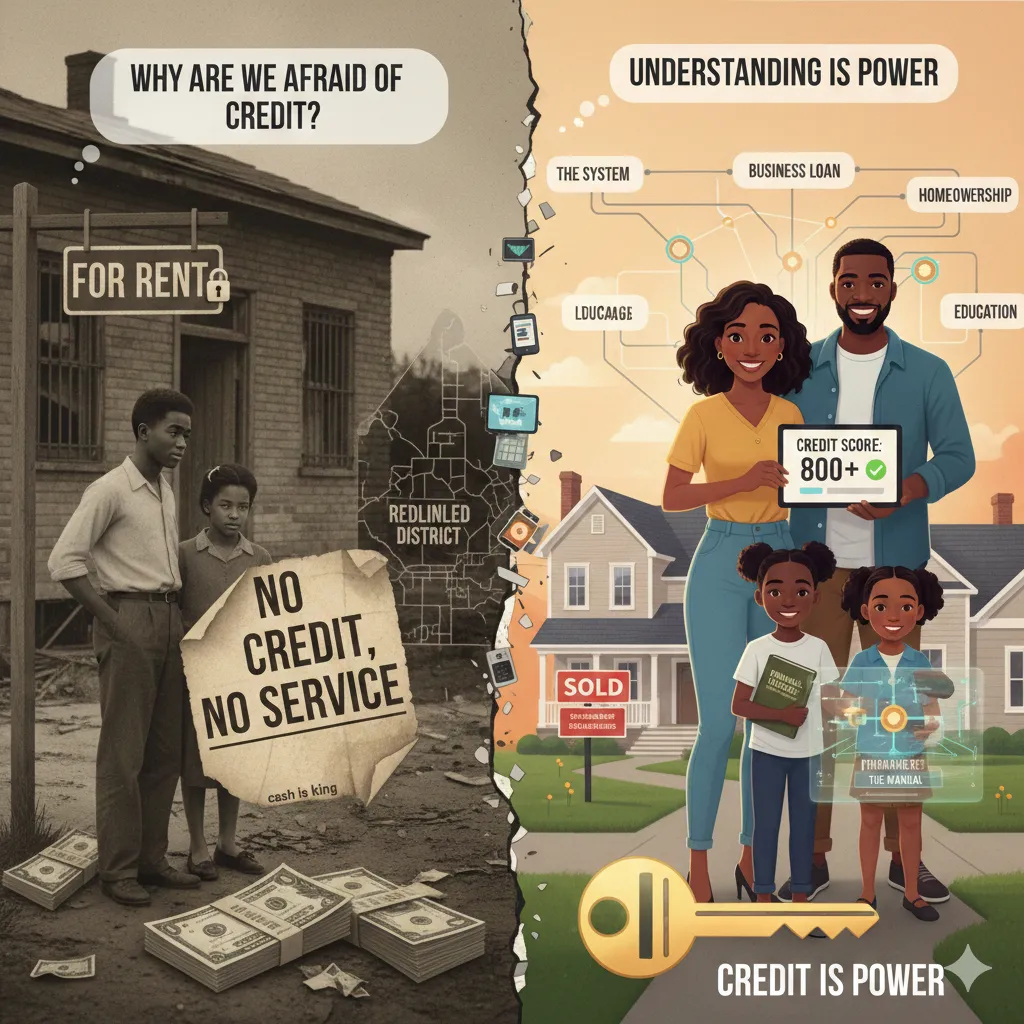
Credit is not just a financial product. It is an operating system. And the Black community was never given the manual.
What Many Black Households Were Taught
For generations, the message was clear and consistent: Work hard, save your money, avoid debt, don’t owe anyone, and stay out of trouble
That guidance wasn’t foolish. It was protective.
At a time when credit was routinely denied, weaponized, or offered under predatory terms, avoidance was rational. Cash meant safety. Debt meant risk. Owing meant vulnerability.
But the system evolved. The instructions did not.
This is not about discipline. It is not about values. It is about education and exposure.
What Credit Actually Is
Most people misunderstand credit because it’s taught emotionally, not structurally.
Credit is not money. Credit is permission. Permission to borrow at lower cost, rent or buy in certain neighborhoods, start a business without paying everything upfront, absorb emergencies without total collapse, and leverage time instead of trading labor endlessly.
Credit is a reputation system institutions use to answer one question:
“How safe are you to do business with?”
That judgment often follows you more closely than your income, your degree, or your effort.
What Good Credit Actually Enables
When credit is understood and managed correctly, it quietly changes the economics of life:
Lower interest rates make everything cheaper
Housing options expand
Business and investment capital becomes accessible
Liquidity exists during emergencies
Assets can be acquired without waiting decades
This is why someone earning less, but using credit strategically, can move faster than someone earning more who avoids it entirely.
Wealth is not just about how much you make. It’s about how efficiently you can deploy capital.
Why Credit Feels Dangerous in the Black Community
This fear did not come from ignorance. It came from experience.
Historically, credit was denied through redlining or offered through predatory structures or punished more severely when mistakes were made.
Over time, credit became associated with stress, shame, loss, and generational damage.
That fear was learned. And it was rational.But rational fear can still become a long-term disadvantage.
Warnings Were Passed Down; Not Instructions
Many of us grew up hearing:
“Don’t owe nobody.”
“Cash is king.”
“Debt will ruin your life.”
What we rarely heard:
how credit scores actually work
why utilization matters
how leverage is used intentionally
how mistakes are repaired, not fatal
When education is missing, fear fills the gap.
Avoidance becomes the strategy. Not because it’s optimal, but because it feels safe.
How Credit Is Often Taught Differently Elsewhere
In many white households, credit is introduced early and treated neutrally.
Children are more likely to be added as authorized users; see mortgages as normal; understand that mistakes are fixable.
Credit is not moralized. It is not tied to character. It is treated like a tool.
The question is never: “Should I use credit?”
It’s: “How do I use it well?”
That difference compounds over decades.
Early Experiences Shape Everything
For many Black adults, first encounters with credit looked like:
store cards with 28–30% interest
overdraft fees
medical debt
payday loans disguised as assistance
That teaches your nervous system to associate credit with danger.
Layer on:
denials without explanation
hidden fees
different treatment by name or zip code
Avoidance begins to feel like protection.
The Hidden Cost of Avoidance
Avoiding credit in a credit-based economy does not make life safer. It makes life more expensive.
It leads to fewer housing options, harder paths to entrepreneurship, emergencies becoming disasters, slower wealth accumulation, and dependence on cash and labor.
This creates a cycle:
limited credit → higher costs
higher costs → slower progress
slower progress → reinforced fear
It feels responsible but it isn’t.
What’s Actually Missing: Literacy, Not Character
The gap is not responsibility. It’s normalization and instruction.
Other communities were not inherently better with money. They simply learned the system earlier and with fewer consequences.
Credit education:
replaces fear with strategy
turns income into leverage
reveals bad deals before they trap you
creates options instead of limitations
Education is protection.
Why This Must Be Collective
When only a few people understand credit:
progress is slow
mistakes are expensive
fear stays unchallenged
When knowledge spreads:
conversations become practical
children inherit structure
norms begin to shift
That is how financial behavior actually changes—not through shame, but through shared literacy.
The Mindset Shift That Matters
Old thinking: Avoid debt.
Better thinking: Learn the rules.
Old belief: Credit is dangerous.
Reality: Ignorance is expensive.
Old strategy: Pay cash to stay safe.
Truth: Cash without credit limits your future.
This Is Bigger Than Money
This is about housing security, ownership, independence, legacy, and control.
Credit literacy is institutional literacy. And literacy is power.
Final Truth
The old narrative says Black people are bad with money. The honest one says we were never taught how the system actually works. And systems do not reward good intentions. They reward understanding.
Avoiding credit does not protect you in a credit-based economy. It makes you invisible. And invisibility costs more than interest ever will.
Receive new research the day it publishes. Subscribe →
