COMMUNITY INTELLIGENCE 001
Deconstructing the Mental Health Stigma in the Black Community
Mental health is one of the most important conversations we still struggle to have honestly. In the Black community, discussions around emotional and psychological well-being are often delayed, softened, or avoided altogether. That silence did not appear overnight, and it is not the result of personal weakness. It is rooted in history, shaped by survival, and reinforced over generations.
To move forward, we have to understand where the stigma came from and why it still influences how we relate to pain today.
Where the Stigma Began
The mental health stigma in the Black community did not begin with our parents or grandparents. It traces back to slavery, where Black people were deliberately portrayed as incapable of deep emotional or psychological pain. This false narrative served a purpose. If Black people were viewed as emotionally shallow, overly resilient, or immune to trauma, then their suffering did not need to be acknowledged, treated, or protected against.
Pain could be ignored because it was never recognized as real.
That lie did not disappear when slavery ended. It carried forward into laws, institutions, medical practices, and cultural expectations. Over time, it shaped how Black pain was interpreted and how Black people learned to interpret their own experiences. Emotional distress became something to minimize. Sadness became something to pray away. Anxiety was reframed as “just stress.” Exhaustion became normal. Trauma became something you survived without ever naming.
We became experts at endurance, but beginners at processing.
When Strength Became a Requirement
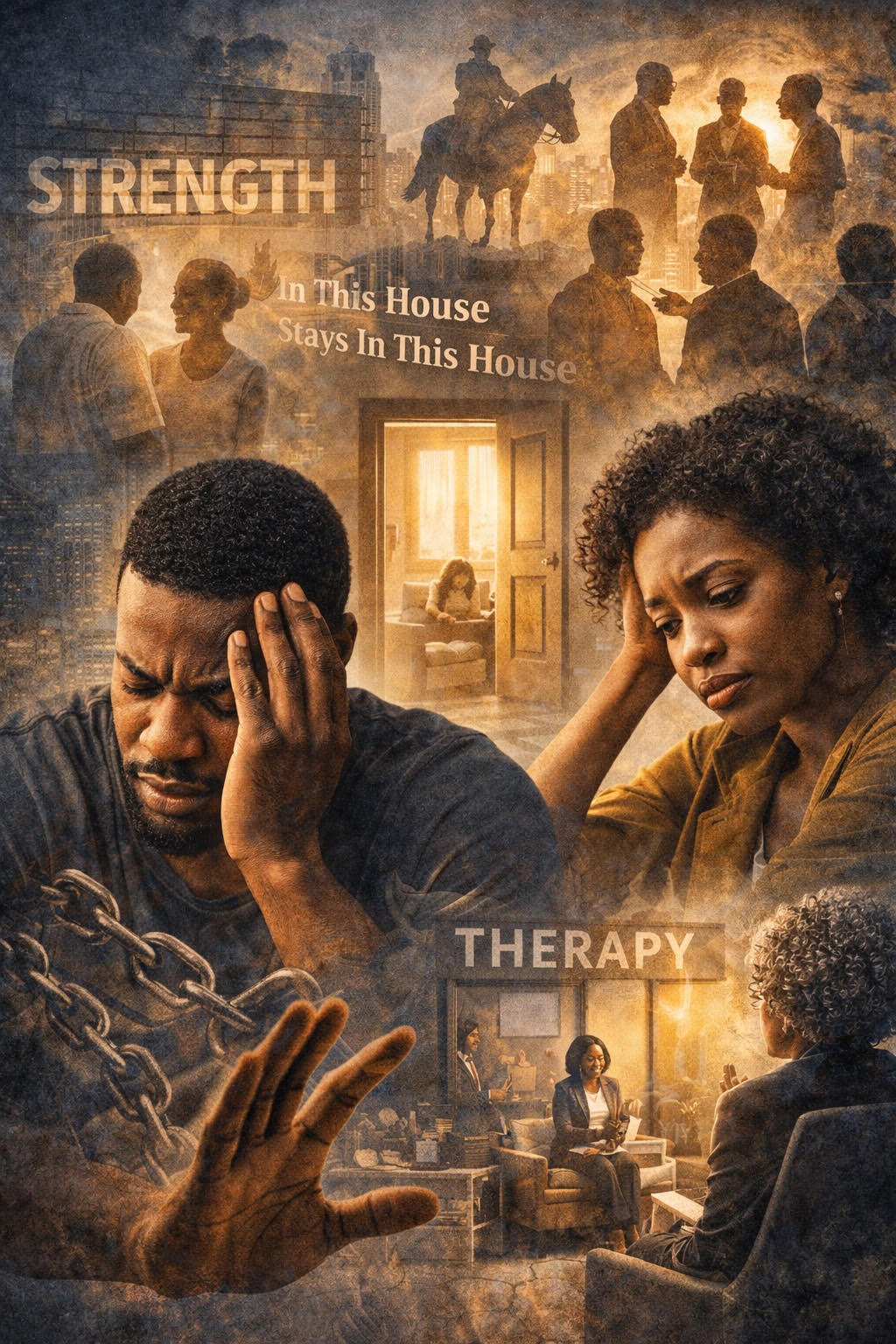
For many Black families, strength was not framed as a choice. It was presented as a necessity. You were expected to keep going, keep providing, keep showing up, and keep it together—regardless of the cost. Rest was treated as something you earned only after everything else was handled. Admitting that you were not okay often felt like failure rather than honesty.
This version of strength was not rooted in empowerment. It was rooted in survival. But survival mode, when it becomes permanent, eventually turns inward. What once helped us endure external harm begins to quietly harm us from the inside.
Racism as a Long-Term Mental Health Stressor
Racism is not only traumatic when it is loud or violent. It is exhausting when it becomes constant. For many Black people, mental health struggles are not tied to a single defining event. They are shaped by daily exposure to being treated differently, having to explain oneself more, staying alert in certain environments, and being expected to handle more with less support.
Over time, these experiences become normalized. We tell ourselves that this is “just how it is,” or that this is simply something you deal with because you are Black. But adapting to unfair conditions still takes a psychological toll, even when it feels familiar.
Therapy does not have to mean that something has gone wrong. It can simply mean that you are living in a society where inequality is built into everyday life. That reality deserves space, not suppression.
Why Therapy Is Not Weakness
Seeking mental health support is not a rejection of strength. It is an acknowledgment of humanity. When stress and struggle are built into daily life, mental health care is not an extra or a luxury. It is necessary.
Therapy provides language for experiences we were taught to ignore. It offers tools for managing stress we normalized without question. It creates space to process what many people were forced to carry alone. It is not about breaking down. It is about refusing to break quietly.
The Weight of Household Silence
In many Black households, mental health is still treated as something to avoid rather than address. This avoidance often comes from love and fear, not neglect. Pain is managed indirectly through silence, distraction, material support, or the belief that keeping the family together matters more than addressing what hurts beneath the surface.
Phrases like “what happens in this house stays in this house” are often meant to protect. But protection can become confinement when it prevents healing. Children raised in silence learn to hide rather than process what they feel. Emotional struggles do not disappear. They remain unresolved.
As those children grow into adults, the impact does not fade. It shows up in relationships, coping habits, and emotional patterns. Pain that is never acknowledged does not end it gets passed down.
When Strength Turns Into Performance
There is also pressure within the community to appear composed, successful, and unaffected. This pressure can quietly turn vulnerability into something rare and risky. When everyone is trying to look put together, real conversations disappear. Comparison replaces care. Competition replaces compassion. Isolation replaces support.
Without vulnerability, nothing actually gets addressed.
Where We Go From Here
Improving mental health in the Black community starts with honesty. Many of the coping mechanisms we rely on today were learned through survival. They made sense in their time. But what helped us endure the past may not serve us in the present.
Change does not happen all at once. It begins when we choose different responses when we talk openly in our homes and circles, when we treat therapy as preventative care rather than a last resort, and when we prioritize healing over appearances. Choosing well-being over performance disrupts cycles that silence has maintained for generations.
Conclusion: Healing Is Infrastructure
At Keystone Black Capital, the focus has always been on building systems that allow Black communities to thrive—not just survive. Mental health is part of that infrastructure. Just as access to capital, education, and ownership determines long-term economic outcomes, access to emotional and psychological care determines long-term personal and community stability.
You cannot build strong institutions on unresolved pain. You cannot scale leadership, decision-making, or generational progress when people are operating in constant survival mode.
Healing is not separate from the work. It is foundational to it.
When we speak honestly, seek support, and normalize care, we do more than help ourselves. We change what gets passed down. And that shift toward clarity, stability, and wholeness is essential to the future Keystone Black Capital is working to build.
Receive new research the day it publishes. Subscribe →
